Table of contents
- Verifying That the Wall Is Truly Non-Load Bearing
- Ensuring Compliance with Building Regulations
- Protecting Property Owners and Developers
- Identifying Hidden Structural Dependencies
- Addressing Temporary Works and Safe Construction
- Fire, Acoustic, and Stability Considerations
- When Is a Structural Engineer’s Certificate Required?
- Professional Assurance from Liba Consulting
- Final Thoughts
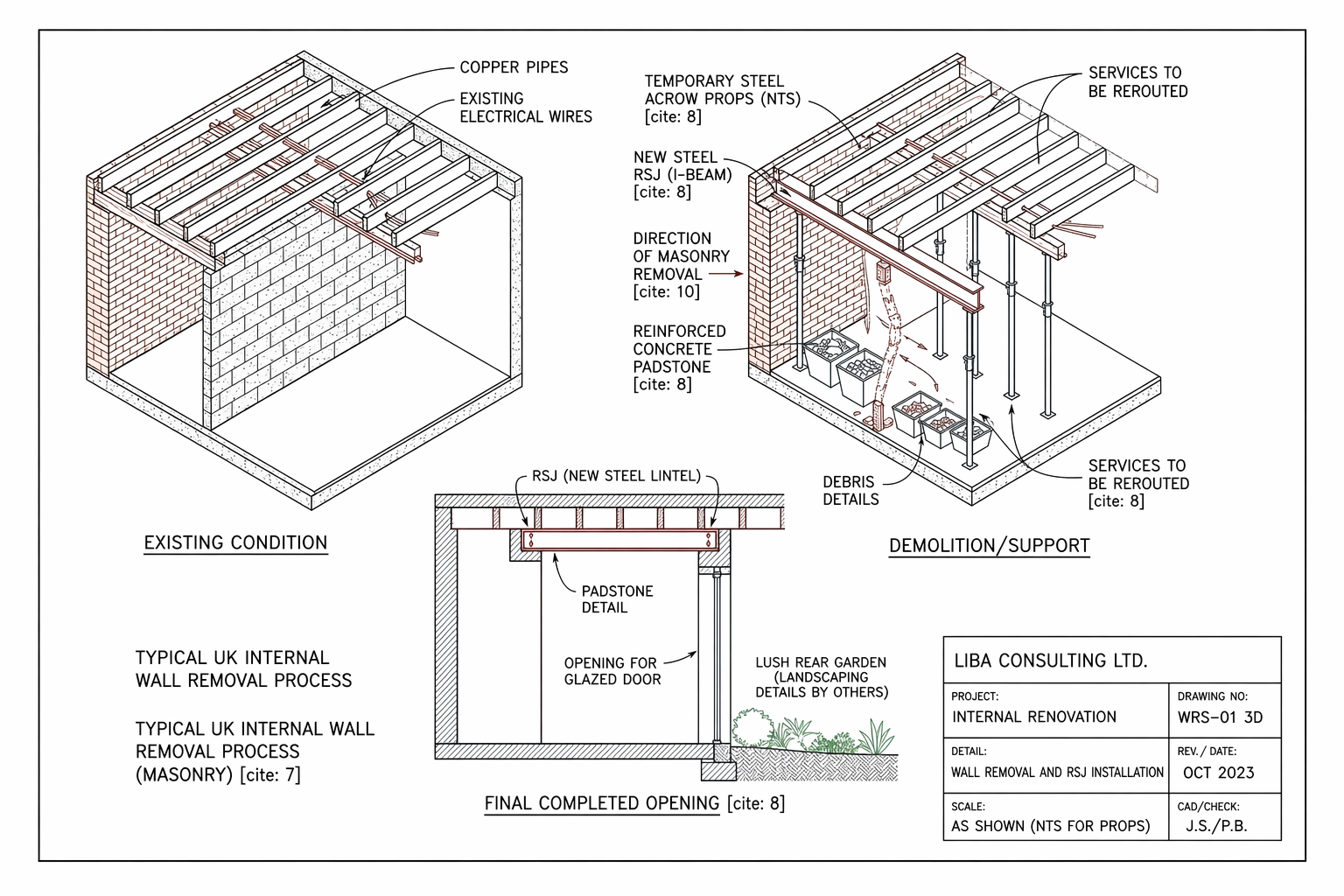
At Liba Consulting, we are regularly instructed to assess and certify wall removals across residential and commercial projects in London and throughout the UK.
Below we explain why certification is essential — even when a wall appears to be non-structural.
Verifying That the Wall Is Truly Non-Load Bearing
The term “non-load bearing” is often used loosely. In reality, many walls thought to be non-structural may:
- Provide lateral restraint to floors or roof structures
- Contribute to overall building stability
- Support beams, joists, or trimmers above
- Act as buttressing to masonry walls
A structural engineer carries out a systematic inspection, reviews available drawings, and assesses load paths to confirm whether the wall is genuinely non-load bearing. This prevents unintended structural consequences such as cracking, deflection, or even partial collapse.
Ensuring Compliance with Building Regulations
Under the Building Regulations 2010, structural alterations must comply with Approved Document A (Structure). Even when removing a non-load bearing wall, Building Control may request structural confirmation that:
- No structural elements are compromised
- Alternative restraint is provided if required
- The building remains compliant with current regulations
A Structural Engineer’s Certificate provides formal confirmation that the proposed works meet regulatory requirements.
Protecting Property Owners and Developers
Certification offers legal and financial protection. Without professional confirmation:
- Insurance policies may be invalidated
- Future property sales may be delayed
- Mortgage lenders may request retrospective structural reports
- Liability risks increase in case of damage
When selling a property, solicitors frequently request structural documentation for alterations. A certificate avoids costly delays and reassures buyers and lenders.
Identifying Hidden Structural Dependencies
Modern and older buildings behave differently. In Victorian and early 20th-century properties common across London, internal partitions sometimes provide unintended support due to historic alterations or timber shrinkage.
A structural engineer evaluates:
- Floor joist spans and bearing conditions
- Load redistribution effects
- Potential need for trimming or strengthening
- Differential movement risks
What appears minor architecturally can have significant structural implications.
Addressing Temporary Works and Safe Construction
Even when a wall is confirmed as non-load bearing, safe removal requires consideration of:
- Temporary propping during demolition
- Sequencing of works
- Protection of adjacent elements
- Vibration and impact effects
A structural engineer may specify safe methodologies to ensure stability is maintained throughout construction.
Fire, Acoustic, and Stability Considerations
Internal walls can also contribute to:
- Compartmentation (fire separation)
- Acoustic performance
- Lateral stability of the structure
Their removal may trigger additional compliance requirements under Building Regulations beyond purely structural aspects.
When Is a Structural Engineer’s Certificate Required?
You may require certification when:
- Applying for Building Control approval
- Selling or refinancing your property
- Undertaking structural alterations
- Removing multiple internal walls
- Altering layouts in older properties
Even where not strictly mandated, obtaining a certificate is considered best practice.
Professional Assurance from Liba Consulting
At Liba Consulting, our chartered structural engineers provide:
- Site inspections
- Structural assessments
- Load path verification
- Calculations where required
- Formal Structural Engineer’s Certificates
We ensure your alterations are safe, compliant, and fully documented.
Final Thoughts

Ready to Discuss Your Project?
Whether you need structural calculations, beam design, support with building regulations, or advice for an extension or loft conversion, we’re here to help. Send us your details and we’ll come back to you with a practical next step.
Read more